
August used to be a large month for WordPress. WordPress 7 ...
![[Revealed] How you can Inform if a WordPress Safety E mail is Actual or Pretend](https://www.wpbeginner.com/wp-content/uploads/2025/01/tell-if-a-wordpress-security-email-is-real-or-fake-og.png "[Revealed] How you can Inform if a WordPress Safety E mail is Actual or Pretend")
Consider opening your inbox and seeing an pressing e mail from ‘WordPress Safety Workforce.’ It warns you that your website has a significant vulnerability and urges you to behave speedy.
You panic. Shedding your website online may imply dropping shoppers, income, or years of exhausting paintings. However right here’s the catch—this e mail isn’t actual.
It’s a rip-off designed to trick you into clicking on a perilous hyperlink.
Sadly, pretend safety emails are turning into extra not unusual. We’ve got heard from many customers who’ve fallen for the rip-off and by chance broken their web sites.
On this information, we’ll display you easy methods to inform if a WordPress safety e mail is actual or pretend.
You’ll find out how those scams paintings, the purple flags to look forward to, and what to do for those who obtain a suspicious e mail. Through the top, you’ll know precisely easy methods to stay your website online secure.
How Those Pretend WordPress Safety Emails Paintings
Scammers are getting smarter. They know website online homeowners concern about safety, so they invent emails that glance legit.
WordPress is the most well liked website online builder, and it’s also very protected. Malicious hackers have a difficult time discovering vulnerabilities in WordPress code, so they’ve to hotel to scamming website homeowners with pretend emails.
Those emails would possibly declare to be from the WordPress Safety Workforce, your website hosting supplier, or a well known safety corporate.
The message generally comprises:
- A caution a couple of vulnerability for your website.
- A connection with a safety flaw with a reputation like “CVE-2025-45124.”
- An pressing request to do so by way of clicking a hyperlink or downloading a safety patch.
However right here’s the trick: the hyperlink doesn’t pass to WordPress.org. As a substitute, it ends up in a phishing website that appears actual however is designed to scouse borrow your login credentials. Some emails additionally ask you to put in a plugin that incorporates malware.
As soon as the scammers achieve get right of entry to in your website, they are able to upload backdoors, redirect guests to damaging websites, and even lock you out totally. That’s why it’s necessary to acknowledge those pretend emails sooner than it’s too past due.
Crimson Flags 🚩🚩: How you can Spot a Pretend WordPress Safety E mail Prior to It’s Too Past due
Recognizing a pretend WordPress safety e mail isn’t at all times simple. Some scammers use emblems, skilled formatting, and technical phrases to make their messages glance official.
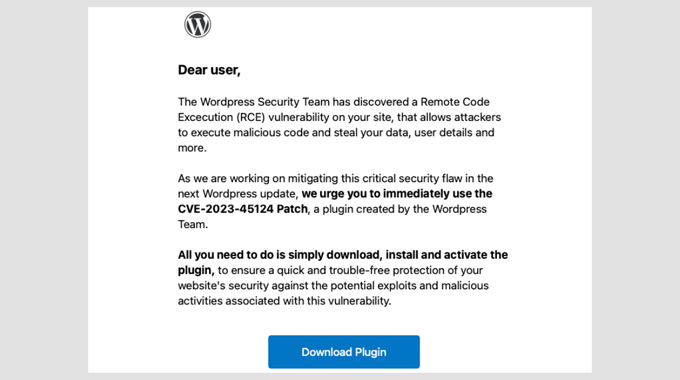
Alternatively, there are particular simply identifiable purple flags that give those scams away. Listed here are the most typical ones:
- Suspicious E mail Cope with: Take a look at the sender’s area. Authentic WordPress emails come from
@wordpress.orgor@wordpress.internet. In the event you see the rest, then it’s a pretend. - Pressing Language: Words like “Act now!” or “Instant motion required!” are designed to create panic.
- Deficient Grammar and Formatting: Many rip-off emails have typos, awkward phraseology, or inconsistent branding. You’ll be able to evaluate it with previous emails from WordPress for readability and tone.
- Hyperlinks That Don’t Fit the Vacation spot: Hover over any hyperlink within the e mail (Do No longer Click on!) to peer the place it leads. If it doesn’t level to
wordpress.org, don’t click on it. - Surprising Attachments: WordPress by no means sends attachments in safety emails. If there’s a document connected, then it’s a rip-off.
- Requests for Passwords: WordPress won’t ever ask to your password or login credentials by way of e mail.
Through the years, we’ve observed all of those tips in motion. One person we labored with even clicked a hyperlink from a pretend e mail and unknowingly gave away their login main points.
Their website was once compromised inside hours, redirecting guests to a phishing web page. Tales like this remind us how necessary it’s to stick wary and examine each element in those emails.
Whenever you get started spotting those purple flags, you’ll really feel extra assured about dealing with suspicious emails.
Keep in mind, taking a couple of seconds to make sure an e mail can prevent from days—and even weeks—of cleansing up your website.
Suppose a WordPress Safety E mail is Actual? Right here’s How you can Know for Certain
On occasion, even probably the most wary website online homeowners hesitate after they see a well-crafted safety e mail.
Scammers are getting higher at making their messages glance actual. Alternatively, there’s at all times some way to make sure authenticity sooner than taking motion.
Right here’s how we way it every time we obtain a security-related e mail:
1. Take a look at the Reliable WordPress Assets
WordPress publishes safety notices on WordPress.org. If an e mail claims there’s a important vulnerability, then test the legit website first.
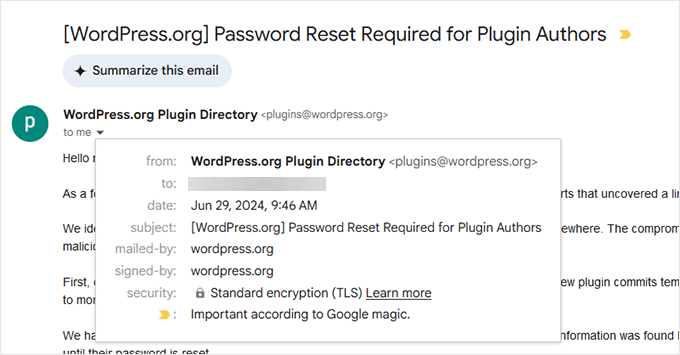
2. Take a look at E mail Sender and Signed Knowledge
Reliable WordPress emails will at all times be despatched from the WordPress.org area title. In some circumstances, they may additionally come from WordPress.internet.
3. Evaluate with Previous WordPress Emails
In the event you’ve gained actual safety emails from WordPress sooner than, you’ll test for variations in tone, construction, and branding.
Pretend emails ceaselessly have awkward phraseology, inconsistent fonts, or fallacious spacing. Reliable emails from WordPress are professionally written and formatted.
4. Search for a Matching Safety Realize from Your Web hosting Supplier
Respected WordPress website hosting firms like Bluehost, SiteGround, and Hostinger submit verified safety updates on their web sites. In case your website hosting supplier hasn’t discussed the problem, the e-mail is also pretend.
5. Hover Over Hyperlinks Prior to Clicking
Prior to clicking any hyperlink, hover over it to peer the place it leads. If it doesn’t level to wordpress.org or your host’s legit website, don’t believe it.
Hackers might use misleading domains that can appear to be a wordpress.org area title however are in truth no longer.
For example, a website known as security-wordpress[.]org isn’t an legit WordPress area title, however some customers would possibly not catch that on time.
6. Use a WordPress Safety Plugin
Plugins like Wordfence and Sucuri observe vulnerabilities and ship actual safety indicators. In case your plugin doesn’t point out the vulnerability, then it’s most likely a rip-off.
One time, a person despatched us a safety e mail that seemed actual. It discussed a plugin vulnerability, integrated a CVE quantity, or even had the WordPress brand.
But if we checked WordPress.org, there was once no point out of it. A handy guide a rough take a look at the e-mail header confirmed it got here from a suspicious area, confirming it was once a phishing strive.
Those fast verification steps assist you to keep away from falling for scams. In the event you’re ever doubtful, wait and examine—actual safety indicators received’t disappear in a couple of hours.
What to Do If You Obtain a Pretend Safety E mail
So, you’ve noticed a pretend safety e mail. Now what?
The worst factor you’ll do is panic and click on on anything else within the e mail. As a substitute, take those steps to offer protection to your website online and file the rip-off.
🫸 Do No longer Click on Any Hyperlinks
Even supposing the e-mail appears official, by no means click on on hyperlinks or obtain attachments. When you have already clicked, then alternate your WordPress password straight away.
🕵️ Take a look at Your Web site for Suspicious Task
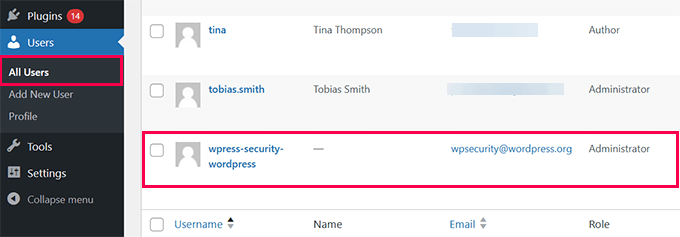
Log in in your WordPress dashboard and search for any unfamiliar admin customers, lately put in plugins, or settings adjustments.
📨 Record the E mail to Your Web hosting Supplier
Maximum internet website hosting firms have devoted safety groups that care for phishing scams. Touch your host’s toughen group and supply information about the suspicious e mail.
🚩 Mark It as Unsolicited mail
Flagging the e-mail as junk mail to your inbox is helping e mail suppliers filter out equivalent messages at some point.
Unsolicited mail filters at large e mail firms like Gmail and Outlook are extremely good and get knowledge from a number of different junk mail filtering firms. While you mark an e mail junk mail, you educate their algorithms to spot equivalent emails at some point and block them.
🔍 Run a Safety Scan
Use a WordPress safety plugin like Wordfence and Sucuri to scan for malware, simply to be secure. For info on how to do that, simply see our information on easy methods to scan your WordPress website for probably malicious code.
One website online proprietor we labored with neglected a pretend safety e mail however later discovered that their WordPress login web page have been attacked.
Thankfully, that they had Cloudflare (loose) arrange on their website online, which blocked malicious login makes an attempt on their website online.
What Occurs If You Fall for the Rip-off?
Clicked on a hyperlink in a pretend e mail? Put in a suspicious plugin? Don’t concern—you’re no longer on my own.
We’ve observed website homeowners panic after knowing they’ve been tricked, however performing temporarily can decrease the wear.
Right here’s what you wish to have to do straight away:
1. Trade Your Passwords: In the event you entered your WordPress login main points, alternate your password straight away. Additionally, it is important to replace your website hosting, FTP, and database passwords to stop unauthorized get right of entry to.
2. Revoke Unknown Admin Customers: Log in in your WordPress dashboard and test Customers » All Customers. In the event you see an unfamiliar administrator account, you wish to have to delete it.
3. Scan Your Web site for Malware: Use a safety scanner plugin like Wordfence or Sucuri to test for malicious information, backdoors, or unauthorized adjustments.
4. Repair a Blank Backup: In case your website has been compromised, you must repair a backup from sooner than you clicked the pretend e mail.
Preferably, you’ll have your individual backups from a WordPress backup plugin like Duplicator. We suggest Duplicator as a result of it’s protected, dependable, and makes it really easy to revive your website online when one thing unhealthy occurs. Learn our complete Duplicator assessment to be informed extra.
Alternatively, for those who don’t have a backup, you’ll take a look at achieving out in your website hosting supplier. Maximum excellent WordPress website hosting firms stay backups and assist you to repair your website online from a blank backup.
5. Take a look at Your Web site’s Report Supervisor
Get entry to your website hosting keep an eye on panel or FTP and search for lately changed information. In the event you to find unfamiliar PHP scripts, they might be a part of a backdoor.
Hackers ceaselessly use misleading names like wp-system.php, admin-logs.php, or config-checker.php to mix in with core WordPress information. Some will also use random strings like abc123.php or create hidden directories in /wp-content/uploads/.
6. Replace WordPress and All Plugins
If an attacker has exploited a vulnerability, then updating your website guarantees they are able to’t use the similar manner once more. Old-fashioned issues, plugins, or WordPress core information might include safety flaws that hackers exploit.
Cross to Dashboard » Updates and set up the newest variations. You’ll be able to see our information on easy methods to safely replace WordPress for extra main points.
We as soon as helped a small trade proprietor whose website have been compromised when they put in a pretend safety patch.
The hacker injected malicious scripts that redirected guests to a phishing website. Thankfully, that they had a up to date backup, and restoring it at the side of resetting passwords stored their website online.
In case your website has been hacked, you’ll practice our step by step information to scrub up your WordPress website online: How you can Repair a Hacked WordPress Web page (Amateur’s Information).
🎯Get Your Hacked WordPress Web page Fixed!
Don’t need to maintain the tension of adjusting a hacked website? Let our WordPress safety mavens blank up and repair your website online.
Right here’s what you’ll get with our provider:
- To be had 24/7 with speedy turnaround time
- Safety scans & malware elimination
- Reasonably priced one-time charges (no hidden fees)
How you can Give protection to Your Web site From Long term Scams
Fighting pretend safety emails is simply as necessary as recognizing them. Whilst scammers will at all times take a look at new tips, taking a couple of precautions can stay your website secure.
- Permit Two-Issue Authentication (2FA): Including 2FA in your WordPress login prevents unauthorized get right of entry to, despite the fact that your password will get stolen.
- Use WordPress Firewall & Safety Plugins: Use a WordPress firewall like Cloudflare after which give a boost to it with a safety plugin like Wordfence or Sucuri.
- Replace WordPress, Plugins, and Topics: Maintaining the entirety up to date prevents hackers from exploiting identified vulnerabilities.
- Examine Emails Prior to Appearing: All the time test WordPress.org and your website hosting supplier’s website online sooner than performing on safety emails.
- Train Your Workforce: If a couple of group contributors paintings for your website, teach them to acknowledge phishing emails and file anything else suspicious.
Through following those steps, you’ll make it a lot tougher for scammers to trick you and stay your WordPress website protected.
Keep One Step Forward and Stay Your Web site Protected
Pretend WordPress safety emails might sound frightening, however now you understand how to identify them sooner than they purpose any harm.
Keep in mind, scammers depend on worry and urgency, however you’ll simply outsmart them by way of staying cool and calm 😎.
Subsequent time you spot a suspicious e mail, take a deep breath, decelerate, and test the main points. You’re in keep an eye on.
Through verifying emails, holding your WordPress website up to date, and the use of the precise safety equipment, you’ll make your website online a miles tougher goal for scammers.
Wish to take your website online safety to the following stage? We’ve got compiled a whole WordPress safety information with step by step pointers. You may additionally like to peer our knowledgeable pick out of the most efficient WordPress safety scanners for detecting malware and hacks.
In the event you appreciated this text, then please subscribe to our YouTube Channel for WordPress video tutorials. You’ll be able to additionally to find us on Twitter and Fb.

WPBeginner Highlight 27: WordPress 7.1, WPVibe AI All over, and a New Option to Report Your Display

WordPress.com Changelog: A New Web hosting Dashboard, a ChatGPT Plugin, and WordPress 7.1
August 14 – 27, 2026 Welcome again to the WordPr ...
30 Aug, 2026 7 Person Liked it

Your WordPress.com Website Now Works from Within ChatGPT
You'll now set up your WordPress.com web page from Ch ...
27 Aug, 2026 6 Person Liked it
Offer Ends Tonight 12 PM
Lifetime Membership with Unlimited Access