




August used to be a large month for WordPress. WordPress 7 ...
Automating your WordPress web page doesn’t must really feel like rocket science.
Gear like Make.com are robust, however for plenty of freshmen, they are able to really feel overwhelming. Between further connection steps and sophisticated setups (like webhooks), it’s simple to get caught ahead of the rest in reality works.
That’s the place a plugin like Uncanny Automator makes a large distinction. It means that you can construct Make.com–genre workflows in WordPress the usage of a easy setup that feels acquainted and simple to keep on with.
You’ll be able to attach your favourite plugins, cause movements in line with what customers do for your web page, or even upload AI-powered duties in only a few mins.
On this information, I’ll display you ways I automatic my WordPress web page to paintings like Make.com.
The purpose is modest: spend much less time on repetitive duties, stay issues working easily, and center of attention extra on rising your web page as a substitute of managing it.

💡Fast Resolution: The way to Upload Make.com-Taste Automation in WordPress
You’ll be able to create Make.com-style automation in WordPress the usage of Uncanny Automator by way of putting in a easy “if this occurs, then do this” workflow, known as a recipe. You select a cause, like publishing a brand new publish, then come to a decision what will have to occur subsequent, equivalent to producing an AI abstract and saving it to Google Sheets. As soon as the recipe is about to Reside, it runs robotically each time that cause happens.
Here’s an outline of all of the subjects that I’ll be overlaying on this information:
Why I Moved Clear of Make.com (And You Can Too)
I moved clear of Make.com as it turned into tougher to control as my web page grew. Whilst it’s a formidable automation software, the setup and upkeep can really feel like an excessive amount of in the event you simply need issues to paintings within WordPress.
Make.com is a visible automation platform that is helping you attach other apps and services and products the usage of workflows known as situations.
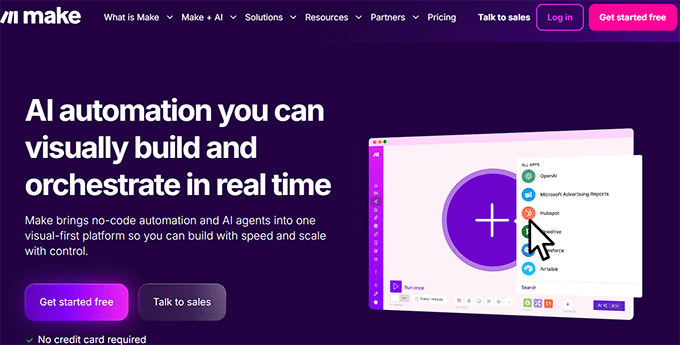
You construct those workflows by way of dragging and connecting blocks, so when one thing occurs in a single app, it triggers movements in any other.
It’s a useful gizmo, however for plenty of WordPress web page house owners, it will probably really feel disconnected from how WordPress in reality works each day.
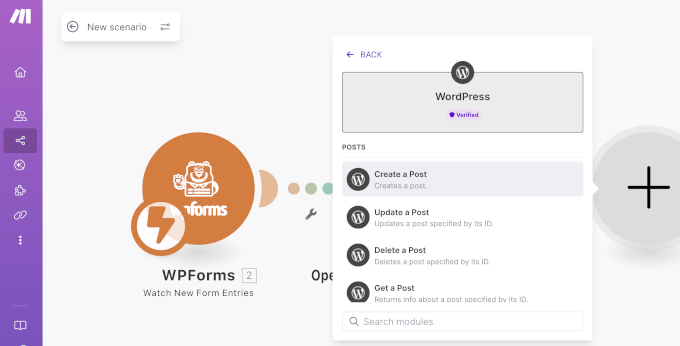
Over the years, I sought after one thing more practical and extra tightly built-in with my web page.
3 Demanding situations That Made Me Transfer Away From Make.com
Make.com stopped operating for me as soon as on a regular basis automations started taking extra time to arrange and handle than the duties themselves.
Listed below are the 3 largest causes I made up our minds to transport away:
| Problem | What It Way | Why It Issues |
|---|---|---|
| Steep Studying Curve | Even easy workflows require hours of tutorials to grasp modules like Routers, Iterators, and Aggregators. | Freshmen can get caught ahead of automations even get started operating. |
| Unpredictable Pricing | Prices rely on “operations,” this means that you pay for each unmarried inner step, clear out, and logical test—no longer simply the general consequence. Processing the very same 500 WooCommerce orders can charge considerably extra in the event you upload a easy clear out. | Arduous to finances as your web page site visitors or gross sales develop. |
| Further Complexity with WordPress | Integrating Make.com calls for APIs, webhooks, and third-party connections. Workflows can smash when plugins replace, | Ongoing troubleshooting slows you down and provides tension. |
At that time, I spotted I wanted an automation answer that felt more practical, extra predictable, and constructed in particular for WordPress.
What Make.com Does In point of fact Neatly
In undeniable English, Make.com is superb when you wish to have quite a lot of ‘if this, then that’ paths and also you’re connecting many apps outdoor WordPress.
As an example, it has:
- A visible flowchart builder that allows you to design automations by way of connecting steps visually, making it simple to know how information strikes from one motion to the following.
- Integrated branching and routing the usage of Router modules, so other movements can run in line with prerequisites you place.
- A big integration library, with get admission to to hundreds of apps and services and products that you’ll be able to attach with out development the entirety from scratch.
- Complex automation good judgment, together with Iterators and Aggregators for operating with lists of knowledge, plus filters to keep an eye on when movements run.
Those options are nice when you wish to have detailed keep an eye on over complicated workflows. Alternatively, for plenty of on a regular basis WordPress automations, they are able to really feel like greater than you in reality want.
When Does The usage of Make.com Nonetheless Make Sense?
Even supposing I moved clear of Make.com, there are scenarios the place it nonetheless works neatly:
- For Apps Out of doors WordPress – If you wish to have to attach gear that Uncanny Automator doesn’t enhance, then Make.com offers you get admission to to hundreds of apps.
- Already Closely Invested – When you’ve constructed a large number of workflows in Make.com, then switching the entirety may not be price it instantly.
- Complex HTTP Modules – Whilst Automator Professional handles maximum webhook wishes, some very complex HTTP requests may nonetheless be more straightforward in Make.com.
In maximum on a regular basis WordPress use circumstances, Automator handles the entirety easily, however it’s just right to understand Make.com can nonetheless be helpful in those situations.
🌟The Resolution: Why Uncanny Automator Feels Like Make.com However More uncomplicated
After working into too many demanding situations with Make.com, I in spite of everything discovered an answer that exams all of the bins: Uncanny Automator.
It’s the most productive WordPress automation plugin that allows you to attach your favourite plugins, WordPress options, and masses of exterior apps. You construct workflows—known as Recipes—the usage of a easy visible builder.

It really works like Make.com, however the entirety occurs within WordPress, so setup is quicker, control is more practical, and scaling your web page is more straightforward.
With Automator, you get the facility of complex automation with out studying new modules, coping with damaged workflows, or gazing your per month prices spike abruptly.
How Uncanny Automator Saves You Cash
Considered one of Uncanny Automator’s largest benefits is cost-effectiveness. Since you pay a flat annual price for limitless Recipes and movements, you keep away from the unpredictable per-operation prices that Make.com can upload as much as.
| Utilization State of affairs | Make.com Est. Annually Price | Automator Professional Annually Price | Annual Financial savings |
|---|---|---|---|
| 500 complicated WooCommerce orders/month | $183 | $149 | $34+ |
| 1,000 shape submissions/month | $348 | $149 | $199+ |
💡 Key merit: Automator means that you can create limitless workflows and movements within WordPress. Whilst exterior gear like OpenAI might nonetheless fee utilization charges, you received’t pay further to Automator only for working the automation itself.
If you wish to see precisely how Automator compares to Make.com in on a regular basis WordPress workflows—and why it’s more practical and quicker—simply amplify the phase beneath:
Technical Function Showdown: Make.com vs. Automator
| Function | Make.com | Automator | Why Automator Wins |
|---|---|---|---|
| Conditional Common sense | Upload a Router module, configure clear out prerequisites, and attach paths | Upload Situation → make a selection box, operator, price → movements run in line with true/false | More uncomplicated to create regulations in line with person habits |
| Processing Lists | Calls for the “Iterator” module to separate information lists the usage of complicated mapping | “Run an motion for each and every merchandise in a listing” → map repeater box → create motion within loop | Automates repeated duties like dealing with orders or shape submissions briefly |
| Knowledge Transformation | Write formulation, JSON, or RegEx | Use tokens ({{user_email}}) + visible Knowledge Formatter (cut up textual content, math, AI abstract) | Means that you can alternate and layout information visually with out coding |
| WordPress-Local Benefit | Calls for API/webhooks → slight delays | Direct database get admission to → fast triggers | Quicker, extra dependable, much less troubleshooting |
Actual-Global Workflow: The way to Automate Weblog Publish Summaries with Uncanny Automator
With Uncanny Automator, you’ll be able to create complicated workflows a lot more simply than with Make.com. You don’t want to fear about APIs or webhooks as a result of the entirety occurs correct within WordPress.
Listed below are a couple of examples of what you’ll be able to do:
- Mechanically upload new WooCommerce orders to a Google Sheet for simple reporting.
- Ship notifications or emails every time a brand new publish is going are living.
- Summarize publish content material the usage of AI and retailer it in a spreadsheet for simple reference.
On this article, I’m going to turn you create a workflow that robotically generates an AI abstract and provides it to Google Sheets every time a brand new weblog publish is revealed.
Right here’s how it’ll paintings:
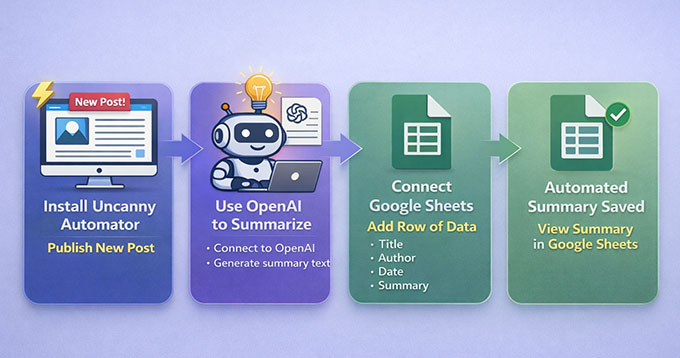
Although you by no means retailer weblog summaries in Google Sheets, this workflow teaches you the precise development you’ll use for automating paperwork, WooCommerce orders, electronic mail reviews, and AI content material throughout your web page.
As soon as you already know this setup, you’ll be able to reuse the similar steps for just about every other automation for your WordPress website online.
What You’ll Want for This Educational:
- A WordPress website online the place you’ll be able to set up plugins (administrator get admission to).
- Uncanny Automator. You’ll want the Professional model for this OpenAI + Google Sheets workflow.
- An OpenAI Platform account with pay as you go credit added.
- A Google account with get admission to to Google Sheets.
- A Google Sheet able. Even a clean one works, however it is helping so as to add column headings upfront, like Publish Identify, URL, Date, and Abstract.
Step 1: Set up and Turn on Uncanny Automator
The very first thing you wish to have to do is about up Uncanny Automator for your WordPress web page.
Get started by way of signing up for an account at the Uncanny Automator website online. Simply click on the ‘Get Uncanny Automator now’ button and keep on with the stairs to create your account.
📍Observe: The loose model contains restricted credit to take a look at app integrations. Alternatively, for an enduring workflow that runs robotically like this one, you are going to want the Professional plan.
Subsequent, pass in your WordPress dashboard to put in the plugins. First, set up the loose core plugin from the WordPress repository. Then, set up the top class plugin the usage of the ZIP report you’ll be able to obtain out of your Uncanny Automator account.
The top class plugin unlocks the integrations you wish to have for OpenAI and Google Sheets. When you’re not sure how to try this, test our step by step information on putting in WordPress plugins.
Upon set up, it’s time to turn on your license. Pass to Automator » Settings to your WordPress dashboard and input the license key out of your Uncanny Automator account.
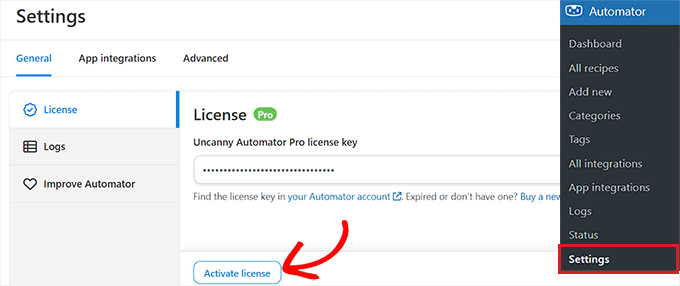
Click on the ‘Turn on License’ button, and your website online can be able to start out growing automation workflows.
Step 2: Attach OpenAI to Uncanny Automator
For this workflow to paintings, you wish to have to attach your OpenAI account to Uncanny Automator. This permits OpenAI to robotically generate summaries of your weblog posts ahead of they’re added in your Google Sheets reviews.
The excellent news is you simplest have to attach it as soon as.
To get began, you’ll want your OpenAI secret key. A secret secret’s a novel code that tells OpenAI it’s actually you the usage of their carrier. It helps to keep your account protected and lets in Uncanny Automator to get admission to OpenAI safely.
To seek out your secret key, log in in your OpenAI account and pass to the ‘API Keys’ tab within the left-hand menu. Right here, click on the ‘Create new secret key’ button.
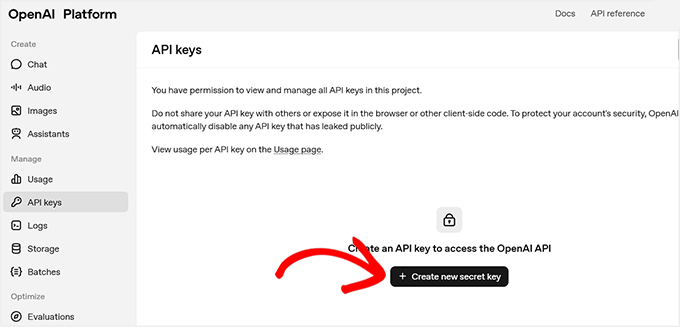
You’ll be precipitated to provide it a reputation—that is simply to your reference, so you’ll be able to determine it later.
📍Necessary: Your OpenAI API account is totally become independent from a ChatGPT Plus subscription. You will have to acquire pre-paid credit to your OpenAI Platform billing settings for the API key to paintings. With out a credit score steadiness, the automation will fail.
While you’ve added credit, click on ‘Create Secret Key’.
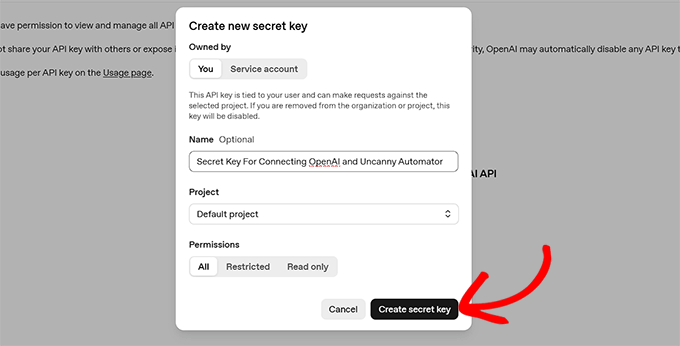
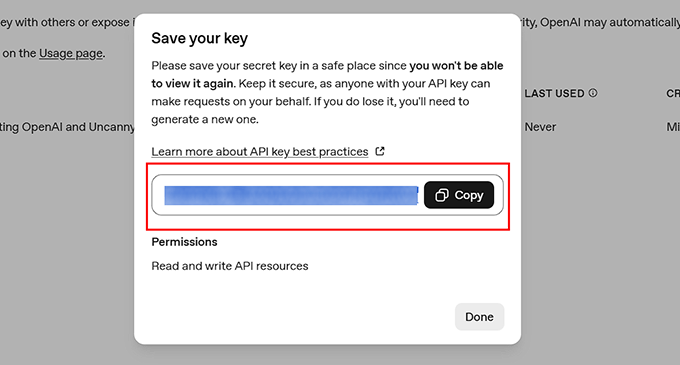
OpenAI will generate the important thing and show it in a popup.
Reproduction this key and retailer it someplace secure, since you received’t be capable to see it once more.
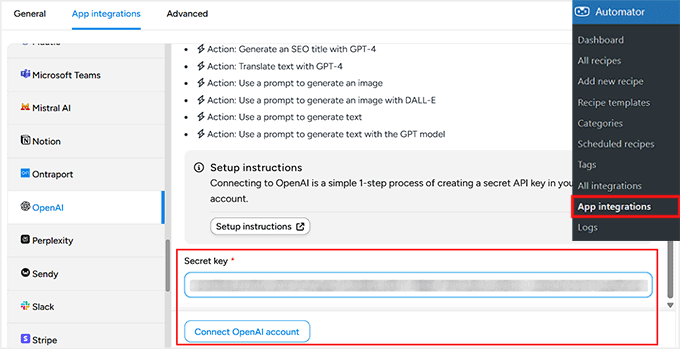
Subsequent, pass in your WordPress dashboard and open the Automator » App Integrations web page. Then, transfer to the ‘OpenAI’ tab at the left and paste your secret key into the ‘Secret Key’ box.
After that, click on ‘Attach OpenAI Account’. As soon as that is completed, your Uncanny Automator and OpenAI accounts are attached.
Now you’re able so as to add triggers and movements the usage of OpenAI to your workflows. This connection lets you robotically summarize posts or carry out different AI-powered duties every time a workflow runs.
Step 3: Attach Uncanny Automator to Google Sheets
The next move is to attach Uncanny Automator to Google Sheets. This may increasingly permit your whole weblog publish summaries to be added in your selected spreadsheet.
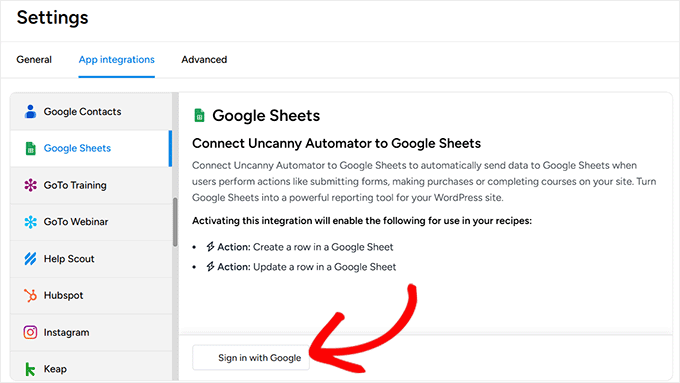
To get began, pass to Automator » App Integrations to your WordPress dashboard and make a selection ‘Google Sheets’ from the left-hand menu.
Click on the ‘Check in with Google’ button and select the account you need to hyperlink. In case your account isn’t indexed, you’ll be able to upload it the usage of the ‘Use Some other Account’ choice.
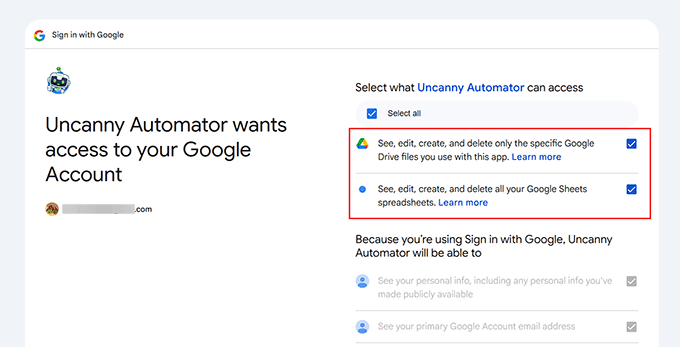
Subsequent, Google will ask for permissions so Uncanny Automator can get admission to your spreadsheets.
That is utterly commonplace, and the plugin simplest makes use of those permissions so as to add new rows to the spreadsheets you choose.
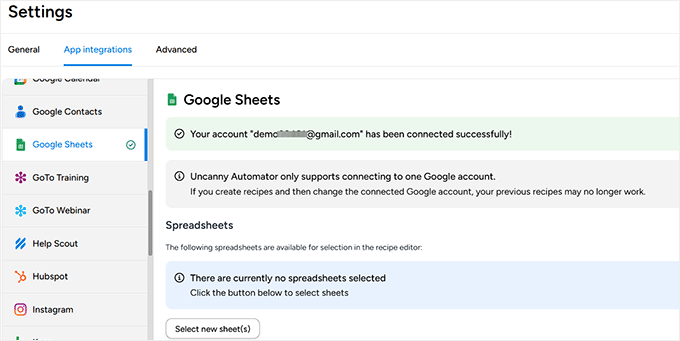
While you approve, you’ll be redirected again in your WordPress dashboard with a affirmation that your Google account is hooked up.
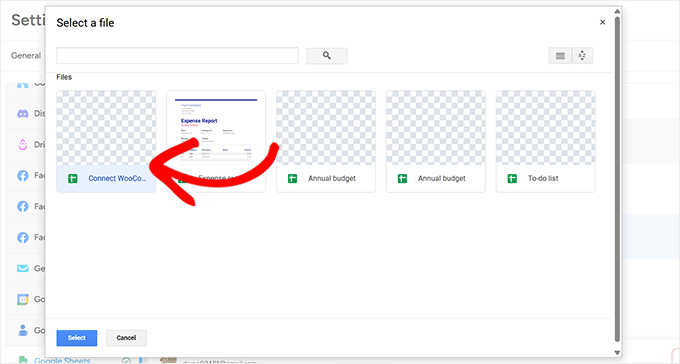
After all, click on ‘Choose new sheet(s)’ and select the spreadsheet you need to make use of for storing your publish summaries.
You’ll be able to upload a couple of spreadsheets if wanted, and all attached sheets will seem within the recipe editor when development automations.
If you need a extra detailed information, take a look at our educational on attach WooCommerce to Google Sheets.
As soon as your spreadsheet is hooked up, you’re able to start out development a workflow that summarizes posts and robotically sends them at once to Google Sheets.
Step 4: Create Your Recipe in Uncanny Automator
While you’ve effectively attached OpenAI and Google Sheets, it’s time to create a recipe in Uncanny Automator.
In Automator, a recipe is what defines your automation. Every recipe has two primary portions: the cause, which begins the automation, and the motion, which is what occurs subsequent.
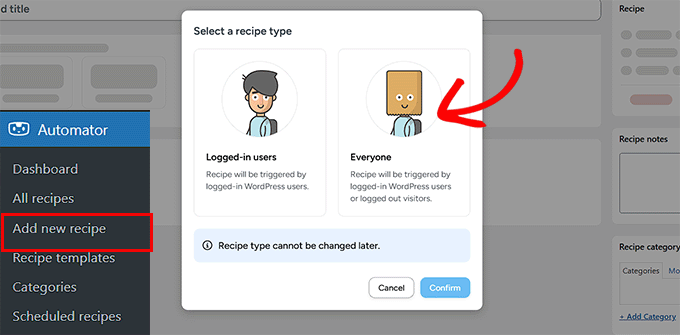
To start out, pass to Automator » Upload New Recipe out of your WordPress dashboard. You’ll be requested to choose from a ‘Logged-in’ recipe and an ‘Everybody’ recipe. Logged-in recipes simplest run when a person is signed in.
For this workflow, I like to recommend settling on Everybody.
Right here’s why: When you time table posts to be revealed robotically at some point, WordPress publishes them within the background (the usage of the gadget cron) reasonably than the usage of a logged-in person. Settling on ‘Everybody’ guarantees the automation runs reliably for scheduled posts, too.
Subsequent, give your recipe a reputation that is smart, like ‘Weblog Publish Abstract to Google Sheets’. This may increasingly can help you determine it later whilst you create extra recipes.
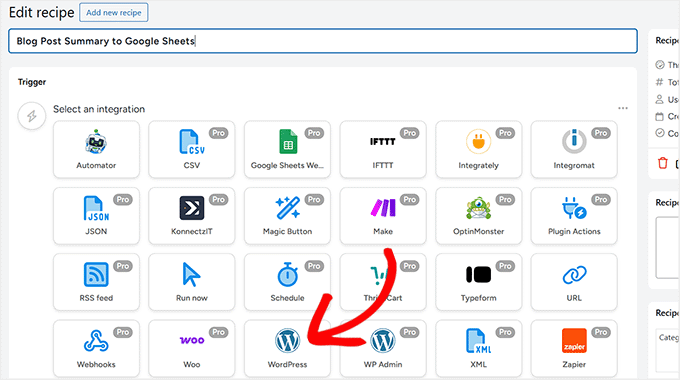
After that, Uncanny Automator will display a listing of all plugins and services and products put in for your web page. Choose ‘WordPress’ as the mixing platform to your cause.
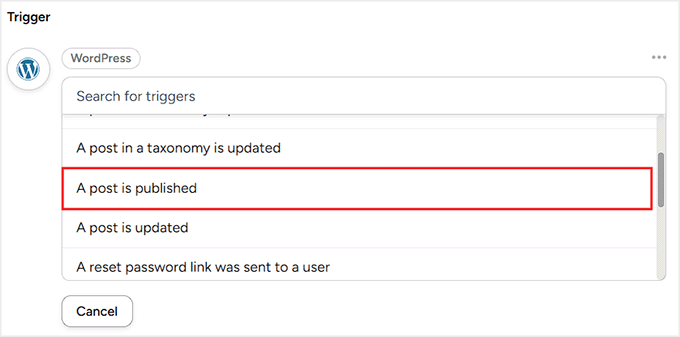
Then, select the development that are supposed to get started the recipe. For this workflow, make a selection ‘A publish is revealed’.
This guarantees that each time a brand new publish is going are living, the recipe will run robotically.
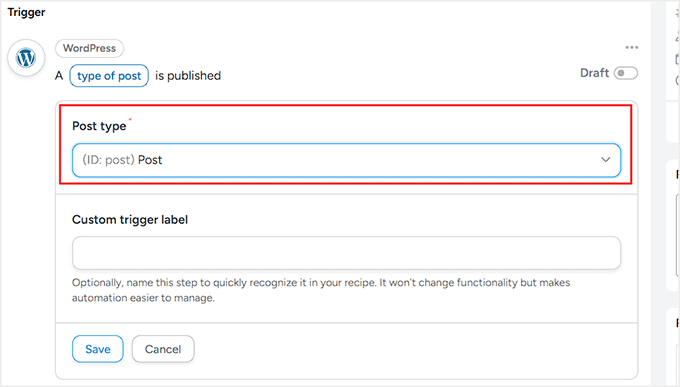
After all, you’ll want to make a choice the publish sort. By means of default, Uncanny Automator applies the cause to all publish sorts, together with posts, pages, and merchandise.
Since this workflow is just for WordPress weblog posts, make a selection ‘Publish’ from the dropdown menu. As soon as that’s completed, click on ‘Save’ to turn on your cause.
Step 5: Upload the OpenAI Motion to Generate Weblog Publish Summaries
Now that your cause is about, it’s time so as to add the primary motion to your recipe: producing a abstract of the weblog publish the usage of OpenAI.
To start out, click on the ‘Upload Motion’ button within your recipe.
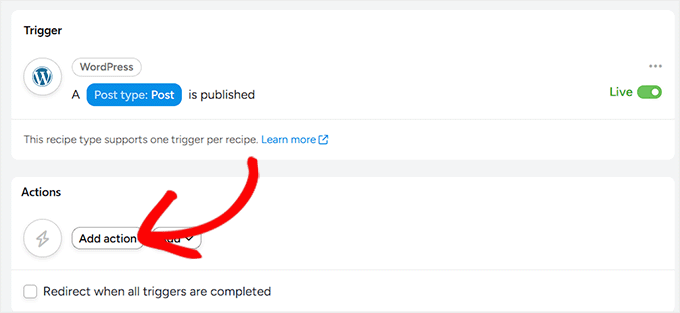
This may increasingly open a listing of integrations to your motion.
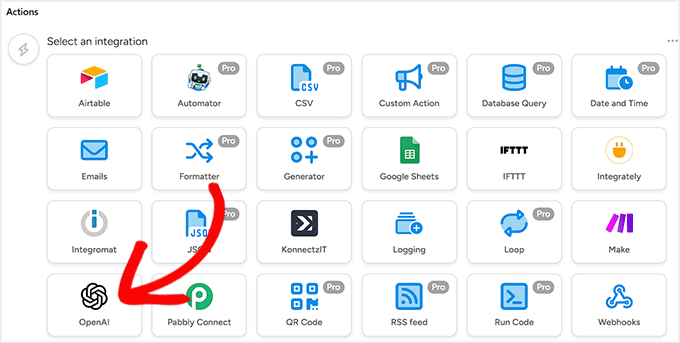
Because you’ve already attached OpenAI, click on on it to make a choice the platform.
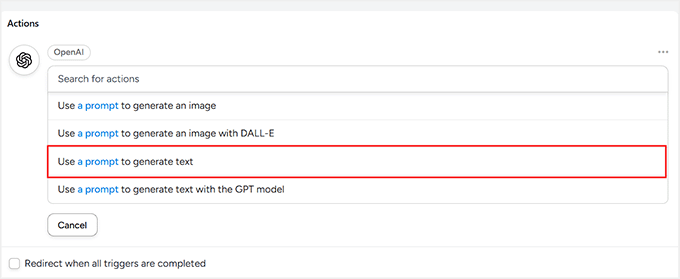
You’ll see a listing of movements OpenAI can carry out.
For this workflow, make a selection ‘Use a urged to generate textual content’. This tells OpenAI precisely what content material to create.
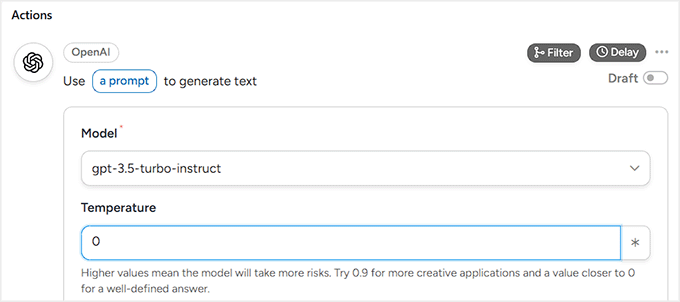
Subsequent, select the OpenAI type. I like to recommend the newest to be had type, because it produces essentially the most herbal and correct summaries.
Now, set the Temperature. This controls how intently the AI sticks to the information as opposed to how ingenious it will get. For a weblog abstract, you need the AI to be predictable and factual, so I like to recommend atmosphere the temperature to 0.
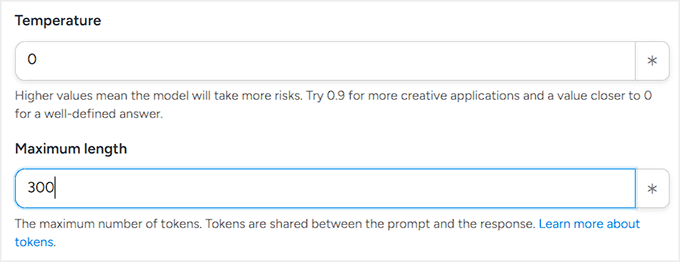
Set the utmost choice of tokens subsequent. Tokens are the devices OpenAI makes use of to measure textual content. Kind of talking, 1 token is set 1 be aware or 4 characters. So a 200-word abstract would want round 300–350 tokens.
Tokens additionally impact pricing. Understand that OpenAI fees for each the textual content it reads (your weblog publish) and the textual content it writes (the abstract). Atmosphere the Most Tokens to 300 guarantees the abstract doesn’t get too lengthy, serving to you keep an eye on your prices.
After all, set your urged. A just right urged obviously tells OpenAI what you need. For this workflow, you’ll want to use one thing like:
‘Create a concise abstract of the next weblog publish content material in round 200 phrases. Focal point on the details and key takeaways: {{Publish Content material (Formatted)}}.‘
When you’re new to making activates for AI, please check out our information to the most productive AI activates for bloggers, entrepreneurs, and social media.
Right here, the {{Publish Content material (Formatted)}} token guarantees OpenAI is aware of precisely which weblog publish to summarize. That is other from an OpenAI API token (the name of the game key you attached previous).
The OpenAI token grants Automator get admission to to OpenAI, whilst those recipe tokens inform the AI which content material to incorporate within the generated textual content.
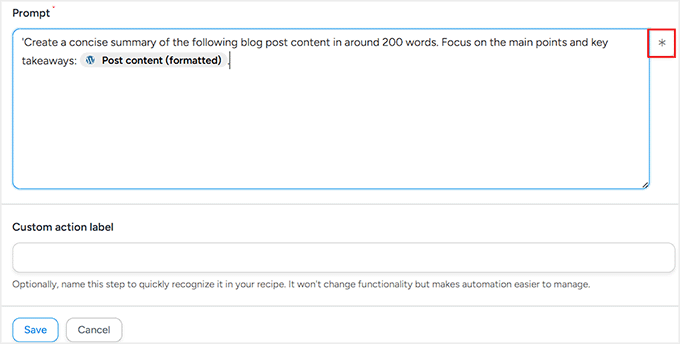
You’ll be able to upload those tokens by way of clicking the asterisk within the urged editor. Uncanny Automator will show a listing of to be had tokens, such because the publish name, writer identify, newsletter date, and extra.
As soon as the entirety is about, click on ‘Save’ to retailer the motion. Your recipe now has a cause and a primary motion that generates concise, AI-powered summaries every time a brand new publish is revealed.
Step 6: Upload the Google Sheets Motion to Retailer Summaries
Now it’s time so as to add the second one motion in your workflow. This motion will robotically create a row to your selected Google Sheet and upload the abstract generated by way of OpenAI.
That is what makes the workflow in reality helpful as a result of your whole publish summaries can be robotically saved and arranged.
So as to add this motion, click on the ‘Upload Motion’ button once more to your recipe. Choose Google Sheets as the mixing this time.
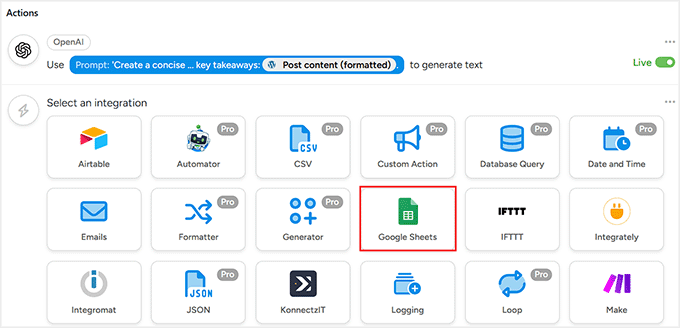
Uncanny Automator will then display a listing of movements it will probably carry out. For this workflow, select ‘Create a row in a Google Sheet’.
This tells Automator so as to add a brand new row in your spreadsheet every time OpenAI generates a abstract for a brand new weblog publish.
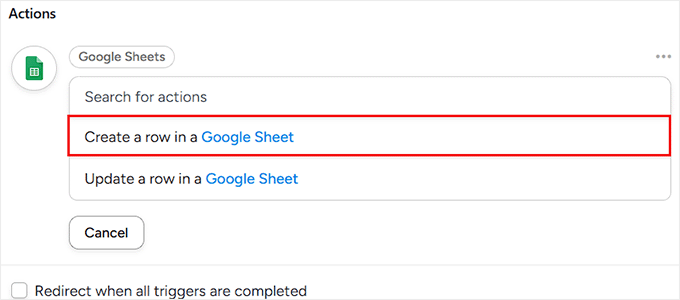
Subsequent, you’ll see a dropdown to make a choice the Google Spreadsheet you attached previous. Select the spreadsheet the place you need to retailer your weblog publish summaries.
Then, make a selection the worksheet (tab) within that spreadsheet.
In case your report simplest has one sheet, you don’t want to fear. But when your spreadsheet has a couple of tabs, be sure to make a selection the right kind one so your information doesn’t finally end up within the fallacious position.

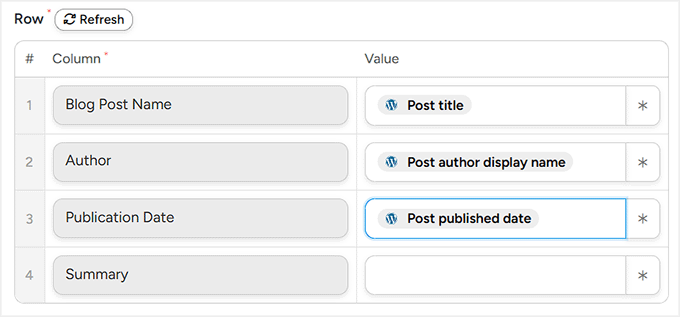
After that, scroll all the way down to the ‘Rows’ phase. That is the place you map your weblog publish information to the columns to your Google Sheet.
Don’t fear, as a result of mapping is more practical than it sounds. You’re simply matching each and every column to your spreadsheet with the precise piece of data out of your publish or the OpenAI abstract.
To start out mapping, click on the asterisk (*) icon subsequent to a box. This opens a listing of to be had information that Automator can pull from the cause (your weblog publish) and the OpenAI motion.
Below the Triggers phase, you’ll see choices like publish name, writer identify, revealed date, and extra.
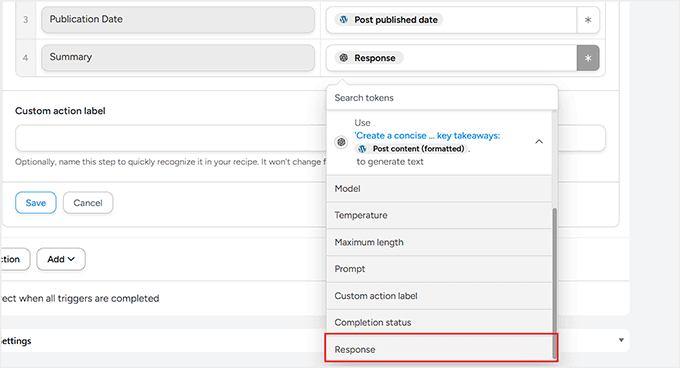
Below the Movements phase, you’ll in finding ‘OpenAI Reaction’, which is the abstract generated by way of AI.
Be certain that to make a choice ‘Reaction’ for the abstract column to your sheet. This guarantees the abstract is robotically added to the right kind column.
Take your time mapping each and every column in moderation.
While you’ve matched all of the fields, click on ‘Save’ to retailer your settings.
Step 7: Save and Turn on Your Recipe
Now that each your cause (a brand new publish revealed) and your movements (producing a abstract with OpenAI and including it to Google Sheets) are arrange, it’s time to make your recipe are living.
Prior to activating, take a second to double-check your whole mappings. Be certain that the columns in Google Sheets fit the weblog publish knowledge, and that the OpenAI abstract is mapped to the right kind column.
This guarantees that each new publish is added accurately with out mistakes.
While you’re assured the entirety is right kind, toggle the Cause and Motion switches to ‘Reside. Then, within the right-hand column, alternate the recipe standing from ‘Draft’ to ‘Reside’.
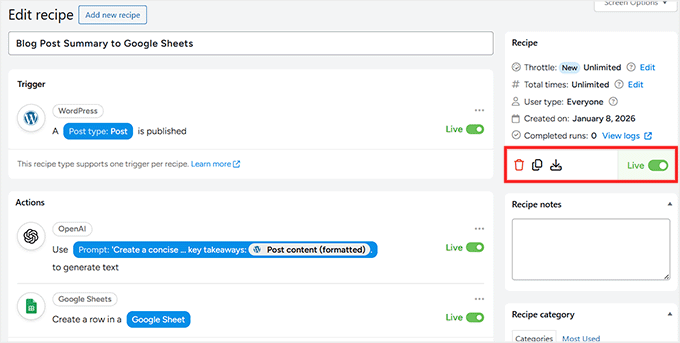
And that’s it! Your automation is now energetic.
To check it, merely pass to Posts » Upload New and post a weblog publish (or replace an current one in the event you set the cause to replace).
Give it a couple of seconds, then test your Google Sheet. You will have to see a brand new row seem robotically along with your AI-generated abstract.
Subsequent Steps for Development Make.com-Taste Workflows Proper in WordPress
Total, after growing workflows with each Make.com and Uncanny Automator, I will be able to hopefully say that development complicated automations with Uncanny Automator is such a lot more straightforward.
Rather than the weblog publish abstract workflow I confirmed above, you’ll be able to additionally create workflows like those, and so they’re a lot more practical to arrange in Uncanny Automator in comparison to Make.com:
| Workflow Instance | Why It’s More uncomplicated in Uncanny Automator | Make.com Complexity |
|---|---|---|
| Ship automatic electronic mail notifications when a person submits a kind, puts an order, or completes a direction | Direct cause from WordPress paperwork, WooCommerce, or LMS, with easy dropdowns for movements | Calls for putting in webhooks, parsing JSON, and mapping a couple of apps |
| Upload new WooCommerce orders to spreadsheets for reporting or bookkeeping | Attach WooCommerce → Google Sheets in mins, with box mapping within WordPress | Wishes a couple of modules, API keys, and knowledge parsing for each and every order |
| Generate AI-powered summaries or content material for posts, emails, or inner reviews | OpenAI integration at once within WordPress, and tokens care for content material dynamically | Should configure HTTP modules, API calls, and care for JSON manually |
| Sync person information between plugins (memberships, LMS, CRM) | Automator reads plugin information natively, and the triggers and movements are easy | Every plugin calls for a separate API setup and webhooks |
| Time table follow-ups robotically (club renewals, direction completions) | Local WordPress occasions cause movements, with out a exterior scheduler | More than one modules, time delays, and further setup in line with platform |
As soon as your first workflow is are living, you’ll be able to hopefully discover and create new automations that save time, streamline processes, and make your WordPress web page smarter.
Often Requested Questions About Uncanny Automator vs. Make.com
Now that you simply’ve noticed how Uncanny Automator can simplify Make.com-style workflows in WordPress, when you’ve got a couple of questions.
To make issues more straightforward, I’ve replied probably the most maximum not unusual questions on AI, automation, and the way those gear paintings in combination:
Can Uncanny Automator care for complicated workflows like Make.com?
Sure! For workflows that most commonly contain WordPress and its plugins, Uncanny Automator can care for them similar to Make.com—however with out the additional setup, APIs, or webhooks.
Do I would like coding abilities to make use of Uncanny Automator?
No coding is needed. The visible Recipe builder and tokens make growing automations so simple as point-and-click.
What’s the adaptation between the Loose and Professional variations of Uncanny Automator?
The Loose model offers you limitless recipes with all of the elementary triggers and movements you wish to have to get began.
The Professional model steps it up with conditional good judgment, loops, scheduled automations, over 150 integrations, or even multisite enhance—principally the entirety you wish to have for extra complex workflows.
Will the usage of Uncanny Automator decelerate my WordPress web page?
No longer considerably. Automator runs movements asynchronously, so web page efficiency is minimally affected—most commonly restricted by way of your server sources.
Will Uncanny Automator summarize my current weblog posts?
By means of default, this recipe simplest runs when a new publish is revealed. It’ll no longer return and summarize your outdated posts robotically. Alternatively, Uncanny Automator Professional features a function to run recipes on current content material if you wish to have to bulk-update your web page.
Can I migrate my current Make.com workflows to Uncanny Automator?
There’s no one-click migration. You’ll want to manually rebuild workflows: Router → Situation, Iterator → Loop, HTTP → Webhook. However as soon as arrange, Uncanny Automator’s WordPress-native integration makes repairs a lot more straightforward.
Further Sources to Take Your Automations to the Subsequent Degree
When you’re able to get much more out of Uncanny Automator, there’s a ton you’ll be able to discover.
From complex workflows to AI-powered automations, listed here are some articles that will help you out:
When you preferred this newsletter, then please subscribe to our YouTube Channel for WordPress video tutorials. You’ll be able to additionally in finding us on Twitter and Fb.

WPBeginner Highlight 27: WordPress 7.1, WPVibe AI All over, and a New Option to Report Your Display

WordPress.com Changelog: A New Web hosting Dashboard, a ChatGPT Plugin, and WordPress 7.1
August 14 – 27, 2026 Welcome again to the WordPr ...
30 Aug, 2026 7 Person Liked it

Your WordPress.com Website Now Works from Within ChatGPT
You'll now set up your WordPress.com web page from Ch ...
27 Aug, 2026 6 Person Liked it
Offer Ends Tonight 12 PM
Lifetime Membership with Unlimited Access